
A double from Harry Kane, as well as goals from Jude Bellingham and Marcus Rashford secured a well-deserved victory for England against Croatia in their opening World Cup game.
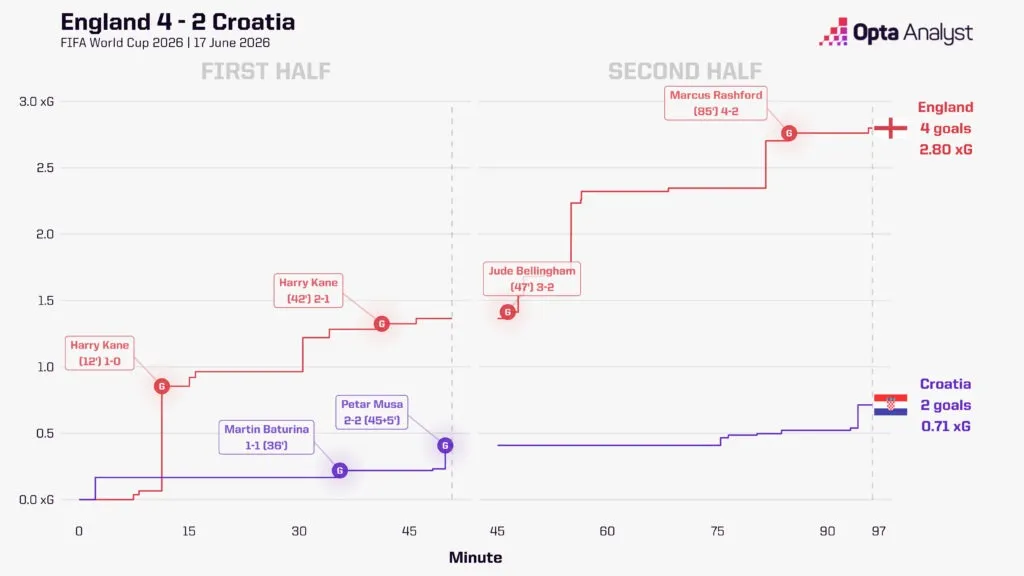
Tuchel’s England side produced an impressive performance, with some fascinating tactical details contributing to a dominant display, in which England produced 3.2 xG, over 4x that of their opponents (0.7 xG; according to FotMob). Here, I look to explore the core principles and details of England’s tactical setup against Croatia, to understand how this important victory was achieved, and how we might expect England to set up further in the tournament.
I will consider how Tuchel’s side set up in possession, both in the build-up and progression phases, with specific details of how Tuchel has built a system to accommodate Harry Kane. Next, I will consider the details of the out of possession setup, including the high press and mid/low block structures. Finally, attention will be given to set-pieces, which generated 1.03 xG according to FotMob.
In Possession
Build-Up
Against Croatia, England set up in a 4–3–3 formation, as we can see from the pass map provided by Opta.
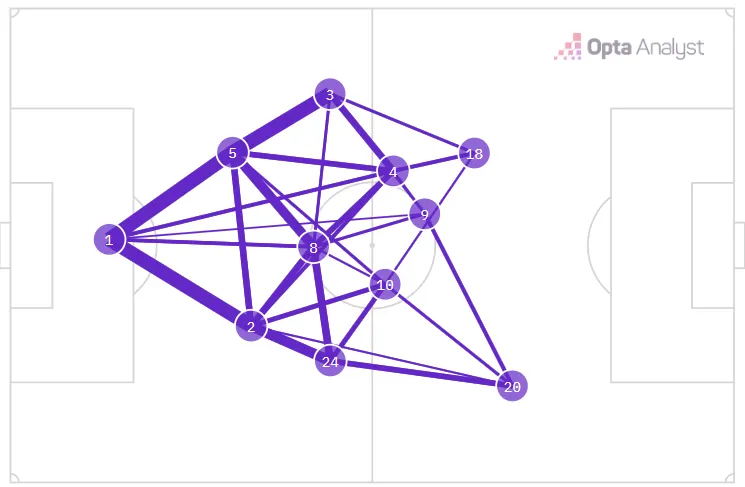
With Croatia pressing man-to-man with a front 3 (in a 3–4–3 shape), Declan Rice (№4) often dropped deep alongside Elliot Anderson (№8), forming a double pivot (transforming into a 4–2–3–1) to help create numerical superiority in build-up.
Croatia’s pressing was intense, as we can see early on in the first half (minute 1:08–1:26), where pressure from the Croatian frontline eventually forces an error from Elliot Anderson, giving away an early corner.
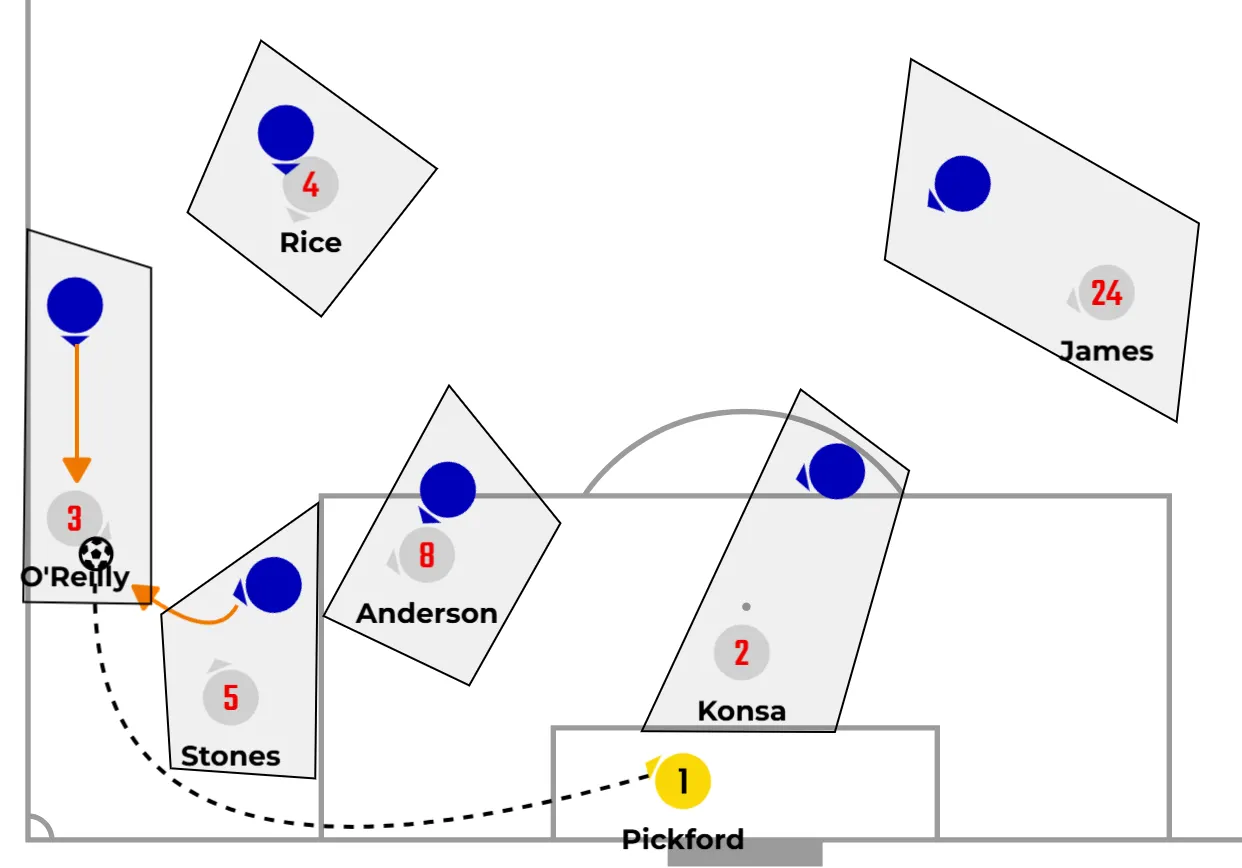
To overcome this intense press, the England centre-backs sat wide, with the full-backs providing width slightly higher up the pitch, with the intention of stretching Croatia’s pressing frontline.
Crucially, in order to disrupt Croatia’s defensive structure and create space, Tuchel’s side looked to utilise wide rotations, providing fluidity between the defence and midfield. A frequent rotation involved Declan Rice dropping into the left-back position, with Nico O’Reilly moving infield.
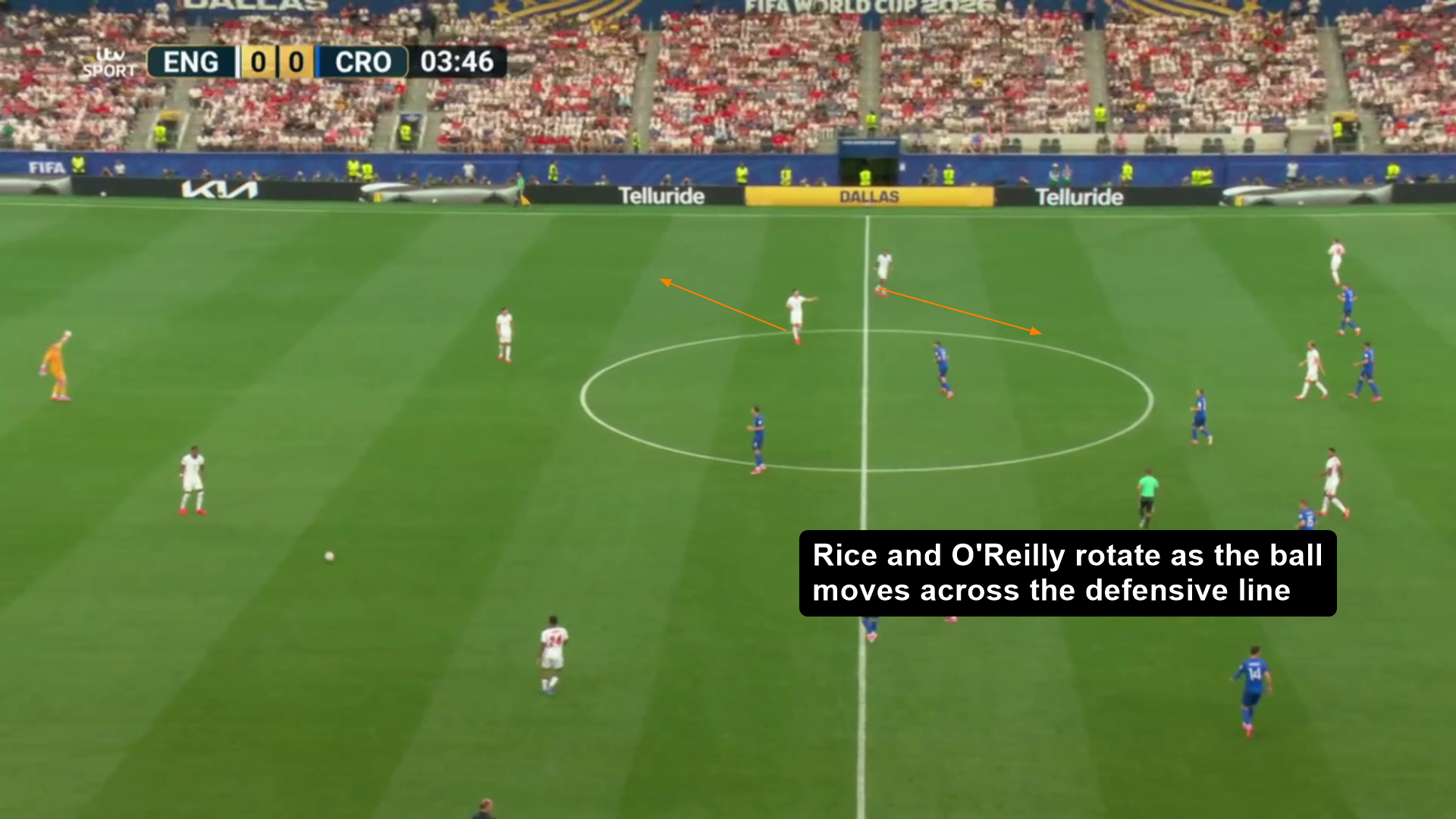
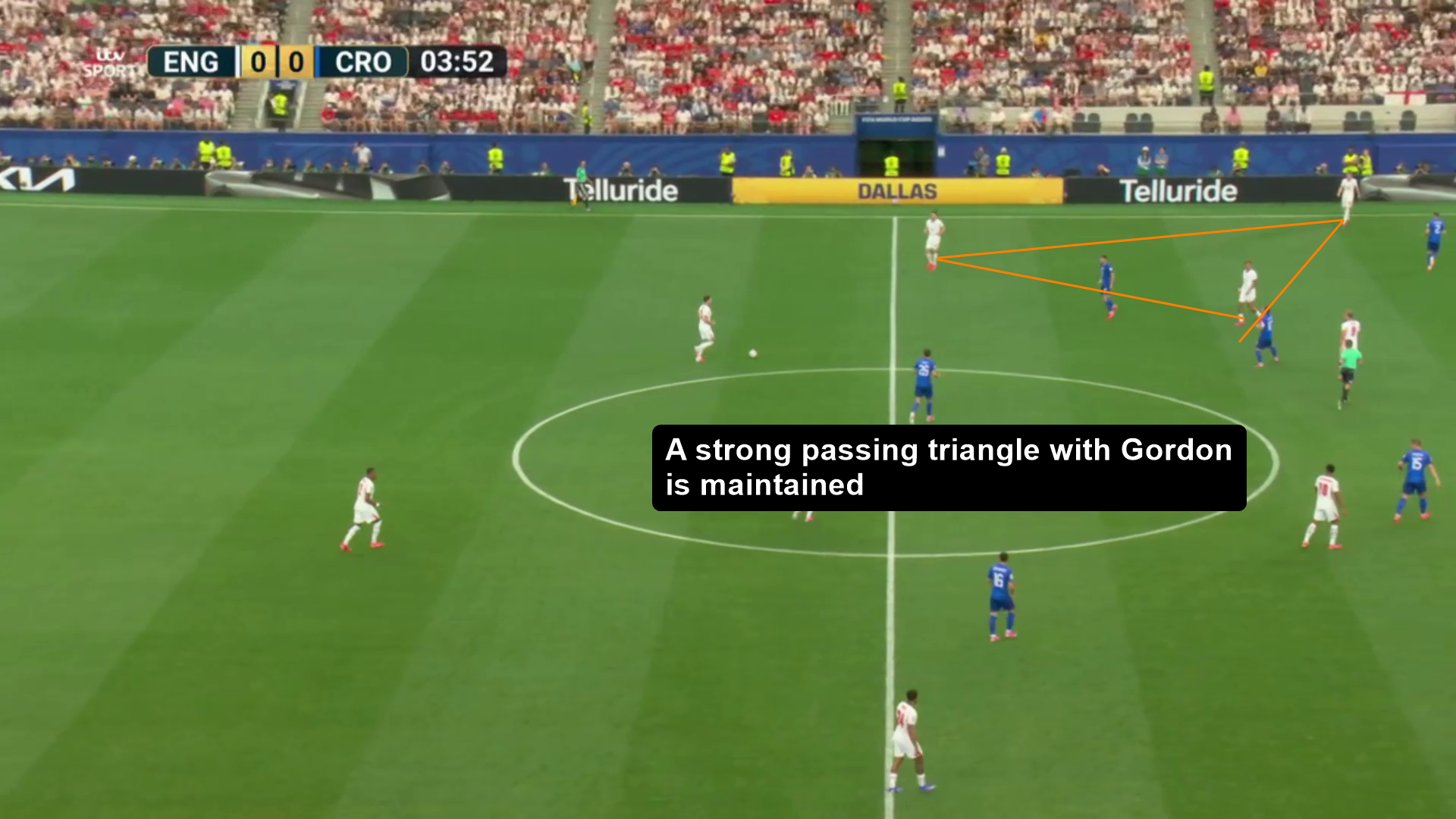
Although less frequent, we can equally see cases of Jude Bellingham and Reece James inverting in such a way. In both cases, the player movements ensure the maintenance of strong passing triangles — or even quads — on either flank.


In both cases, the rotations make England’s build-up more unpredictable, asking difficult questions of Croatia’s defensive players. However, despite these rotations being seen throughout the first half, England struggled to make use of their possessions.
Although we have established that there was a clear intention to play through Croatia’s press, England played with little confidence in the first half, often leading to the failure to progress the ball. As a result, a high volume of long balls were played — often hurriedly and prematurely — leading to frequent turnovers. In particular, Jordan Pickford frequently played the ball long when under pressure, which was exploited by Croatia, who triggered a press any time he received the ball. The nervousness of England’s performance was addressed by assistant coach Anthony Barry during his half-time interview, and clearly Tuchel’s half-time words had an impact on the England XI’s confidence, as their build-up in the second-half was far more impressive; the proportion of passes that were long dropped from 10% in the first half to 7.5% in the second half.
The first half also highlighted the weakness of performing wide rotations in such a manner; namely, a weakness in structure during defensive transitions.
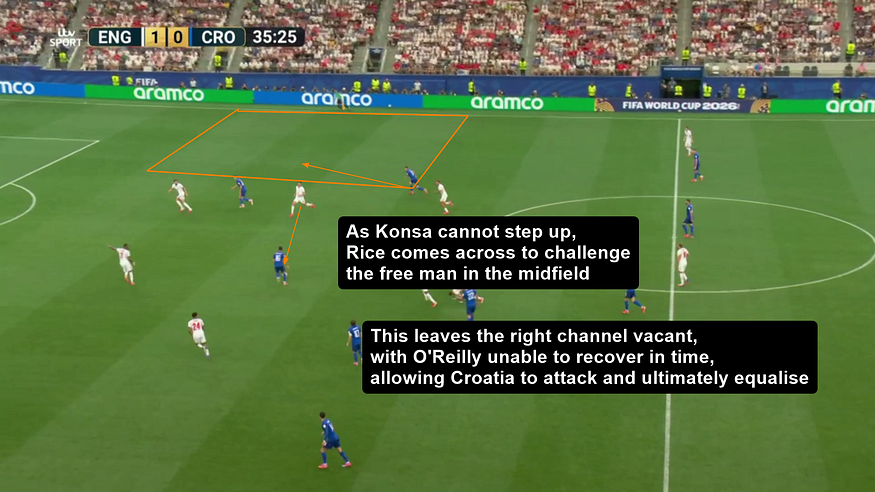
Considering Croatia’s first goal, England lose the ball in the middle third of the pitch, with Rice covering the left-flank and O’Reilly inverted. Anderson — whose poor pass led to the turnover — steps up to press the Croatian player in possession, losing this duel. As Rice is positioned wider, this leaves the centre of the pitch vacant and available to be attacked.

With Konsa and Stones unable to step up, Rice comes across to challenge the free man in the midfield. In doing so, with O’Reilly too far up the pitch to recover, the right flank opens up to be attacked. This goal illustrates how rotations can lead to gaps in the structure of a team in the case of a defensive transition.
Progression — Accommodating Kane
In the middle third, England again show fluidity achieved through off-the-ball movements and rotations. From the 4–3–3 / build-up 4–2–3–1 shapes, England can shift into several different shapes, primarily to accommodate the movements of Harry Kane, who has a tendency to drop deep in order to spray passes forward, utilising his elite passing range. Ultimately, Tuchel’s tactical setup is built to platform Kane, offering a number of runners for him to play the ball towards as he drops deep.
3-4-3
Considering the most extreme of scenarios, when Kane drops all the way into the defensive line to receive the ball from a centre-back or Pickford, the team shifts into a 3-4-3 shape, with Bellingham, Madueke and Gordon staying high and offering runs in behind, and the 2 full-backs offering width.


Again, we can see a 3–4–3 structure formed as Anderson drops into the defensive line, allowing Kane to drop into midfield. Bellingham rotates with Kane, forming a front 3 alongside the two wingers.


2-2-4-2
Furthermore, Rice dropping deeper during build-up enables Kane to follow into the space he vacates, dropping into the midfield to receive the ball to feet. In these scenarios, he ends up at a similar height to Jude Bellingham, with England shifting into what is essentially a 2–2–4–2, with the full-backs providing width and both Madueke and Gordon tucking in to form the frontline, threatening to make runs in behind.

With Kane dropping in to help progress the ball, England essentially shift into a 2–2–4–2, in which Madueke and Gordon can be seen sitting narrower, and James and O’Reilly provide width.

2-3-5
Finally, in the second half we can see an attacking shift initiated by inversions by both full-backs, allowing both Rice and Bellingham to step up alongside Kane, forming an attacking 2–3–5 structure in which width is held by the two wingers.

Note how, in each of these cases, the team shifts relative to Kane’s movements to accommodate him. Tuchel has built the team around his №9, giving him the freedom to make decisions, and coaching the team to respond to these movements. This flexibility in possession asks some difficult questions of the opponents, making England unpredictable, and offering multiple solutions to break teams down.
Progression — Using Wide Combinations
In the 2nd half, England dictated play much more confidently. Playing short during build-up, they could look to bait the press, before adopting a more direct approach when entering the middle third, looking to rapidly get the ball forward and exploit space created. Such spaces are created by off-the-ball movements and rotations which create unpredictability and overload the opposition defence, which is demonstrated by England’s 3rd goal.
Here, Reece James, initially positioned on the Croatian defensive line, drops deep to show for the ball. The Croatian left wing-back (Perisic) follows, and as soon as James receives the ball, Madueke and Bellingham make runs from deep to attack the space on the right flank. James lays off the ball to Anderson, who then plays the ball into this space, where Bellingham picks it up and drives forward before scoring.


Later in the 2nd half, we can see a similar attacking move down this right flank. Djed Spence, playing at right-back, receives the ball. With Morgan Rogers positioned in-field, he is able to lay off the ball, who has Saka as an available option in the passing triangle.

Rogers carries the ball, moving towards the byline. This vacates space for Spence to make an underlapping run into midfield. He continues this run, looking to enter the defensive third. Rogers plays a pass in behind, creating a shooting opportunity.


Finally, England’s fourth goal was created as a result of wide combinations on the right-hand side.
Spence receives the ball from Konsa. Spence plays the ball to James, who can play forward to Saka (the third man). In this example, England use a wide combination to beat Croatia’s high press.


As Saka receives the ball, both Spence and James look to get forward and make underlapping runs. This desire to get forward and support the attack perfectly represents the intention and confidence which defined England’s second-half performance. As Saka took on his man, these underlapping runs continued, meaning 3 England players were in close proximity to the ball, creating an overload on the right-hand side.
Playing with a back 4 at this stage, Croatia commit 4 men to defend the right-hand side, including both centre-backs, the left-back, and a tracking left-mid. This leaves just the right-back in the middle of the pitch, who is pinned by Kane, positioned to receive the ball in behind.

This leaves Rashford completely unmarked on the far side as England recover possession. Saka plays the ball across to Rashford, who cuts onto his right foot to finish well.

These passages show how wide passing triangles are effectively used by Tuchel’s side when progressing the ball, as well as how off-the-ball movements can create space for direct attacks through third-man runs. Such movements are crucial to Tuchel’s system, and were responsible for both of England’s second-half goals. Showing confidence and playing with high intensity, England dominated the 2nd half, registering 13 shots with 9 on target and producing 1.96 xG.
Out-of-Possession
High Press
When pressing high, England looked to go man-to-man. For the majority of the game, Croatia set up with a back 3. England went man-to-man in a 4–3–3 shape, with Gordon, Kane and Madueke taking one centre-back each. The two more advanced midfielders — Rice and Bellingham — were tasked with marking the Croatian double pivot.

The wing-backs are tracked by either England full-back (here, O’Reilly steps up to pressure the right wing-back). In this case, one of the two Croatian attacking midfielders drops deep to show for the ball, causing Stones to step up out of the defensive line to track his run. This intense man-to-man press is highly effective, causing Croatia to play the ball long. England win the aerial duel and recover possession.


This system, in which O’Reilly must jump to press the right wing-back, does come with some risks, however. On one occasion, O’Reilly committed to the challenge and was beaten, penetrating the first line of England’s defence.

Press enter or click to view image in full size

The ball is moved forward and with England now in a back 3, the space on the right flank is exploited. Stones must come across and cover, however Croatia cut the ball back and create a shooting opportunity.


While this press can be effective, therefore, it is important that it is executed correctly. If the press is beaten, the opposition can effectively counter-attack through the wide areas. In particular, I can see this being a problem if England come against Spain later in the tournament. Against Cape Verde, Spain progressed the ball in a 3–2–5 shape. If, therefore, England adopt their 4–3–3 pressing shape, O’Reilly will be tasked with pressing Lamine Yamal if he drops to show for the ball. If beaten, the right-hand side will be vulnerable, allowing Yamal — or Fabian Ruiz, who may drift across — to exploit this space on the counter.

Later in the match, Croatia shifted into a back 4. When pressing man-to-man, England shifted into a 4–4–2 shape, with Rogers (RCM) stepping up alongside Kane. Here, the two midfielders (Bellingham and Anderson) track the Croatian double pivot, and the wingers are responsible for the full-backs.

Expect to see the exact pressing shape utilised by England to change depending on the opposition’s formation.
Mid/Low Block
At times, England sat off the Croatian backline. Sitting in a mid-block, England adopted a 4–4–2 shape, even when Croatia were playing with a back 3. Looking to deny central spaces, the English press would be triggered by the full-backs when the ball was received by the Croatian wide players.
In this mid-/low-block shape of 4–4–2, players still seemed to follow some man-to-man principles. This often resulted in one of the two holding midfielders tracking a run and dropping into the defensive line, forming a 5–3–2 or 5–4–1 if Bellingham dropped to fill in.

However, this desire to go man-to-man made England overly reactive to Croatian player movements. Looking at the 2nd Croatian goal, we can see how going man-to-man leads England into a 7–3 defensive structure, giving the Croatian midfield time to consider their options.

As Baturina drops into the midfield, both Anderson and Bellingham are attracted, looking to mark him more tightly. This leaves a gap in the defensive line for Perisic to attack. The lack of pressure produced by the 7–3 shape allows Pasalic in the Croatian midfield the time to play a beautiful chipped ball over the top of the English defensive line. Bellingham is unaware of Musa on his blindside, who eventually scores a beautifully-worked Croatian goal on the stroke of half-time.


In order to avoid goals like these from being conceded, I believe it is important that England commit to a more structured, zonal 4–4–2 low-block shape, and avoid going man-to-man in these areas to prevent disrupting the defensive structure.
Set-Pieces
With set-pieces growing in importance in the Premier League last season, naturally England have also adopted set pieces and we can expect them to be an important source of goals at this World Cup. Looking at attacking set pieces, we can see that England deployed 4 different corner routines, with 3 involving similar principles to create first-ball shooting opportunities.
Utilising Declan Rice’s elite ball delivery — particularly outswinging corners — England look to create a ‘free man’ in each routine.
Firstly, a routine was used to exploit Croatia’s largely zonal marking strategy. Around the penalty spot, 3 England players wait in close proximity, with 2 Croatian defenders. The England players go man-to-man, leaving Konsa free.

As Rice delivers, the England players screen for Konsa, giving him a mostly uncontested heading opportunity. This corner routine resulted in Madueke picking up a second ball and winning England a penalty.

The same routine was utilised for England’s second goal, with Kane now the free man instead.


Another routine was utilised, in which O’Reilly is left as the free man at the far post. Kane and Stones, positioned again near the penalty spot, make forward runs, which are tracked by their markers. The Croatian defenders are alert to Kane’s movements, particularly as he scored from the free header in the first half. Konsa, at the far post, screens his marker, leaving O’Reilly completely unmarked on the defenders’ blindside, where Rice delivers the ball for a free header.


Another routine was used which, again, involves O’Reilly making a blindside run as the free man. O’Reilly starts positioned at the far post. Meanwhile, Stones, Kane and Konsa, again, go man-to-man near the penalty spot.
As the ball is delivered, all England players occupy their marker. O’Reilly makes a darting run into the area occupied by the England players, where he gets a free header.


A final routine was used, in which Madueke represented a short option. It is worth noting that, looking at the other routines used, Madueke is always available short. This affects the positioning of the defenders in the box, as one defender must step forward and prepare to press. As a result, the box is less crowded, meaning the free man has a better chance of getting on the ball. In this case, however, the short option was used.
In this routine, England set up as they have previously, with Konsa as the free man in the box. The ball is played short to Madueke, and Anderson sits on the edge of the box ready to receive in a shooting position.


Each of these attacking set-piece routines follow a similar principle; occupy your marker, and create space for the free man. These routines were used to great effect, particularly given Rice’s superb ability to place his deliveries. England were unlucky not to score at least 2 more goals, with one of O’Reilly’s headers going just wide, and another being spilled by the keeper, creating a second-ball scoring opportunity.
Conclusion
Here, I have described some of the core principles and patterns which define Tuchel’s England side, including the use of wide rotations to progress the ball, and off-the-ball movements to offer fluidity. This flexible approach crucially accommodates Harry Kane’s movements, and when England play with confidence, they can dominate strong opposition, as demonstrated against Croatia, who placed 3rd in the World Cup 2022.
Additionally, I discussed how England set up to press man-to-man, and in the mid-/low-block. The approach England takes is likely to change between different opponents, however I believe that, to improve, England should commit to a more disciplined 4–4–2 low-block to retain their defensive structure, rather than allowing themselves to be drawn in with man-to-man principles.
Finally, I also considered the range of set-piece routines used by England. Each routine looks to create space for one individual, who can then get a free header and thus a scoring opportunity. In every case, a short option is also available to fashion a shooting opportunity from the edge of the box, or to deliver from a different angle.
There is plenty to be excited about as an England fan. The intensity on display in the 2nd half against Croatia shows how the team can play with intensity and desire, and the late substitutes show how the depth of the team can allow this intensity to be kept up. As the squad gain more experience playing together, I am confident that England can become a real challenger at this World Cup.