Prime Video’s docuseries A Beautiful Obsession follows Pep Guardiola’s Manchester City across the 2024/25 and 2025/26 seasons. This intimate view ‘behind the curtain’ offers a brilliant opportunity to explore Guardiola’s style of management and tactical ideas.
Here, I look to break down every instance of Guardiola offering clear tactical instructions to his side. I will explore the intention behind each action, accompanied by footage of these ideas in practice (where available). The ideas presented by Guardiola can be considered within the broader framework of positional play (Juego de Posición), particularly through 2 key principles - (i) manipulating the opponent to create space and (ii) creating numerical superiority through overloads. Additionally, we can see an example of Guardiola’s more recent pragmatic adaptations, a consequence of the rise of transitional football in the Premier League. In these instances, we can consider the principle of (iii) attacking space directly.
1) Creating Space
“The objective is to move the opponent, not the ball.” – Pep Guardiola
Episode 1: 4:30 - Tottenham (Carabao Cup)
Before a cup tie against Tottenham, Guardiola explains to his team how Tottenham’s aggressive man-oriented press could be manipulated to open passing lanes, allowing vertical line-breaking passes.
Watching the game replay provides some important context behind Guardiola’s instructions. Man City set up in a 4-1-4-1, with Foden playing in a false nine. During build-up, one full-back - typically Lewis - would invert to produce a 3-2-5. Postecoglou’s Tottenham set up in a 4-3-3 man-oriented press high up the pitch.
Guardiola describes a situation in which Tottenham’s RCM (Kulusevski) goes tight against Gündoğan, and their LCM (Sarr) goes tight against Lewis (pictured below).
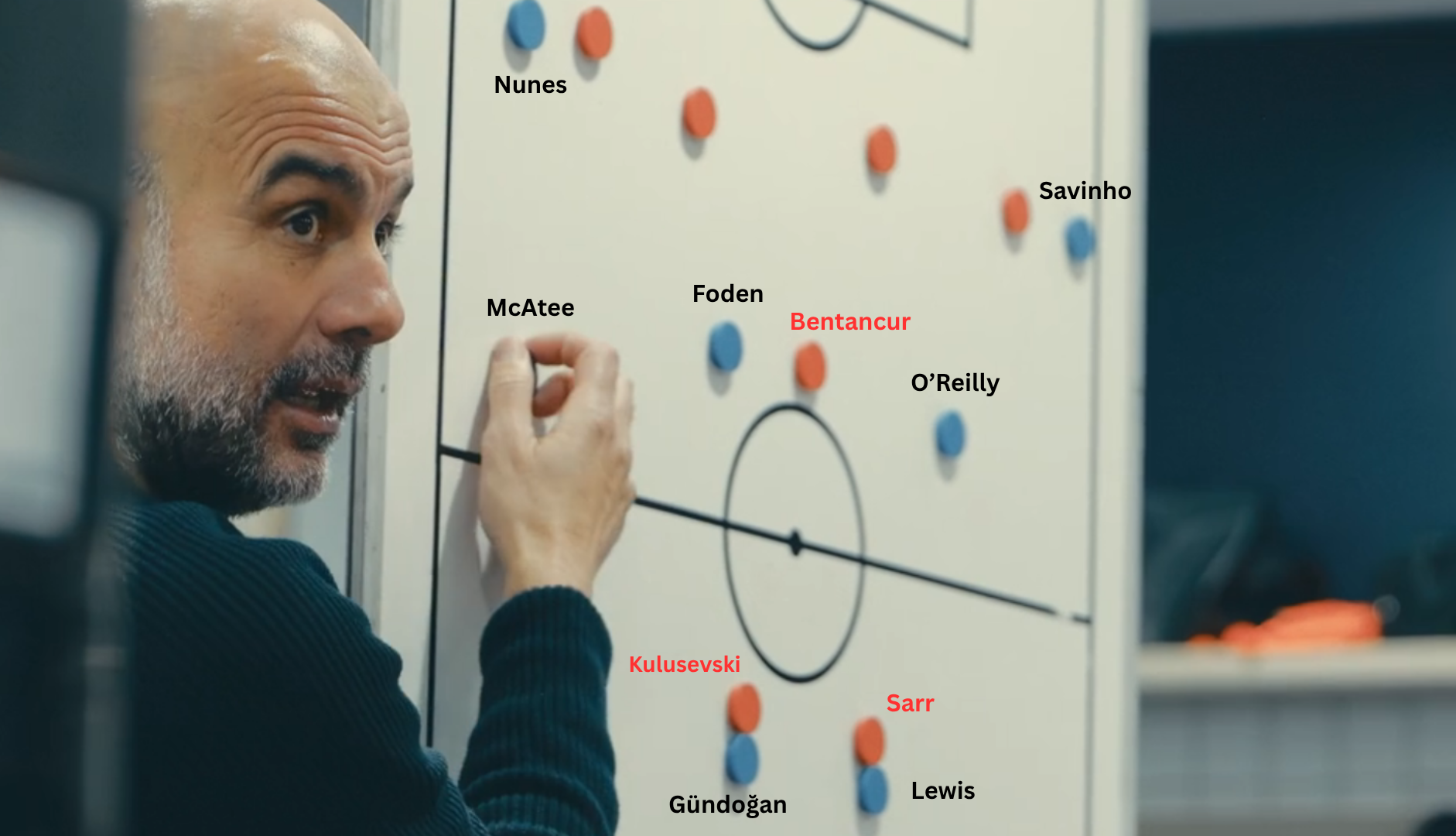
This leaves Bentancur as the only central midfielder protecting space between the lines, creating a 2 vs. 1 situation in the midfield, with Bentancur responsible for both No.10’s (McAtee and O’Reilly). Guardiola recognises this potential superiority and addresses the two midfielders…
“You are here, Macca [McAtee]. Move a little bit on your left side, right? That channel, right? Here. Even you [O’Reilly] because it’s just Bentancur. Just Bentancur.”
… and then Foden:
“Phil, you are here. They are narrow, they open, and you come. Because we can always find that pass [through the central channel] with you.”
The movement of the two No. 10’s into the half-spaces creates a difficult situation to manage for Bentancur; if the ball is shifted wide, staying close to Foden leaves a man available to receive in the half-space:
However, if Bentancur shifts across to mark the No.10, Foden may be free to receive the ball to feet through the central channel:
A possible response is one of Spurs’ two CB’s stepping up on to Foden, at the risk of leaving space in the backline which may be attacked through an inside run from City’s wide player, or the far-side No.10. Again, the movements across City’s frontline ask difficult questions of Tottenham’s defensive players:
Finally, one of Tottenham’s more advanced midfielders could peel away from their man to mark the near-side No.10, leaving Bentancur to mark Foden. However, this allows Lewis or Gündoğan to receive freely and look to progress the ball.
In the game, we can see a couple of occasions where similar movements occur, with McAtee and/or O’Reilly drifting into the half-space. On one occasion, McAtee’s movement causes Bentancur to peel away from Foden, leaving him free to receive the ball centrally. In another example, Bentancur (who is more advanced, with Sarr holding) peels away from Gündoğan to mark McAtee. In both cases, the midfield movements create a free man.
The ideas on display here are typical of Guardiola’s approach. In 2014, Spielverlagerung published an article titled ‘Juego de Posición under Pep Guardiola’, discussing the general principles of positional play and Guardiola’s tactical philosophy. Over 10 years later, these same principles are visible in Guardiola’s teams.
“The players positioned in between the opponent’s lines should constantly move in order to have an open passing lane between them and the ball, or between them and a player who has an open passing lane in relation to the ball. … if a player checks into a space to receive a ball very quickly, the defenders might match this intensity and follow the player and leave a free space to be exploited, or a free man.”
This is the dilemma Guardiola looked to create against Tottenham, with O’Reilly and McAtee’s movements serving to manipulate the opposition, opening passing lanes to either Foden, or the near-side attacking midfielder, depending on Bentancur’s movements.
Episode 1: 8:45 - Sporting CP (UEFA Champions League)
Later in the same episode, we are presented another example of Guardiola instructing his team to manipulate the opponent to open passing lanes. In particular, Guardiola provides guidance on how to manipulate Sporting CP’s double-pivot.
In this example, Guardiola has his team laid out in what appears to be a 3-1-6, with City’s right-back Rico Lewis inverting and advancing forward to occupy the half-space.
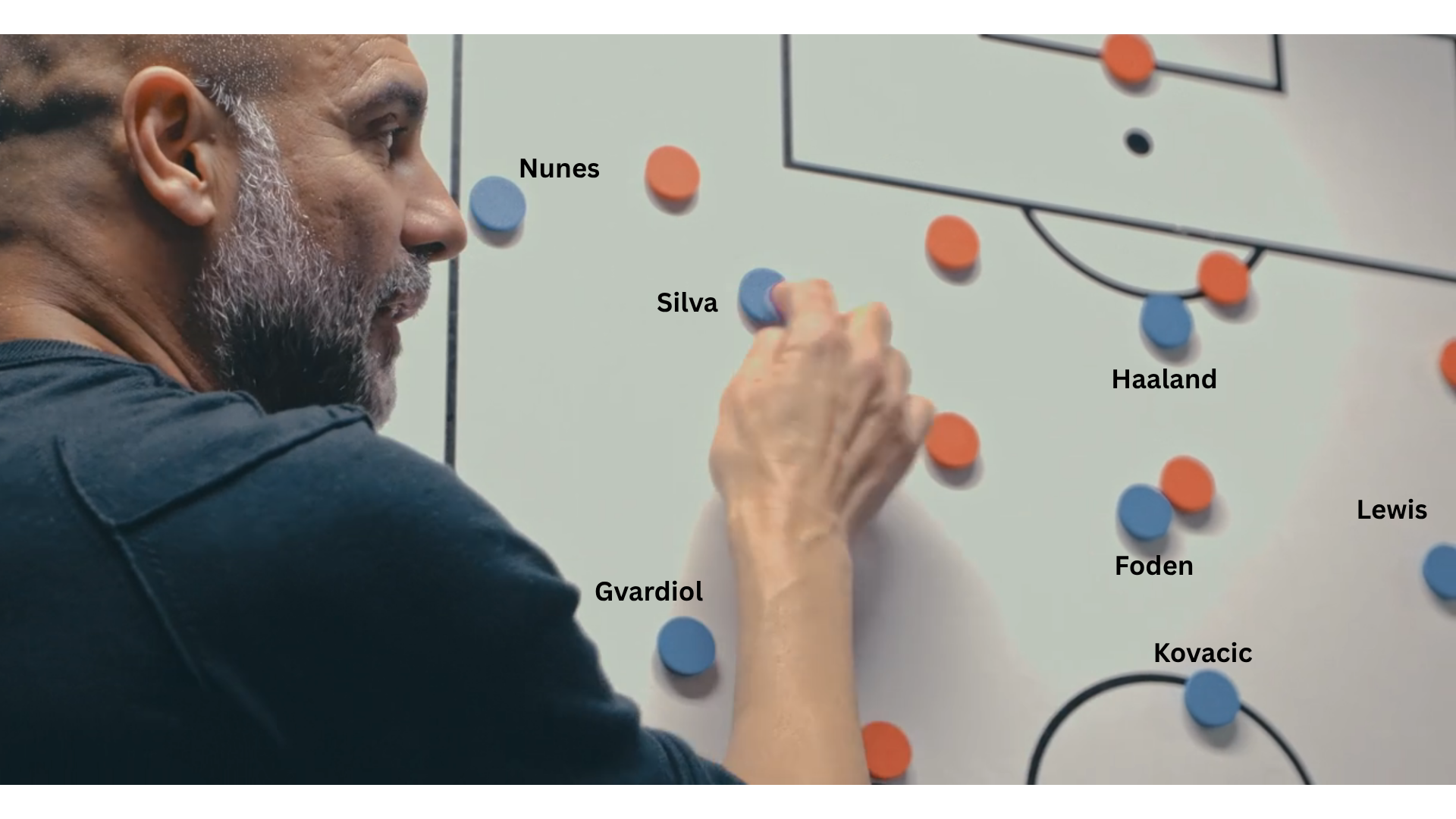
With Lewis stepping up into midfield, an overload is created. To exploit this, Kovačić is instructed to pass in the reverse direction to his ball-carrying movement; as the ball is carried, Sporting CP’s midfield will shift. Moving the ball against the direction of this movement, Man City can access the free player on the other side of the block:
“When you’re going that way and that way [carrying the ball left], it’s here [passing right]. When you go and carry the ball this way [right], it’s here [passing left]. And, after, try to make a movement, and continue with the passes. Just here, desire in your eyes; ‘I’m going to score.’”
As the opposition full-backs are pinned by City’s wingers, they are unable to step onto the wider attacking midfielders. Equally, the opposition centre-backs are not likely to be willing to step out of the defensive line into midfield and leave Haaland in a 1-on-1 situation. This demonstrates the importance of pinning to allow overloads to be created in the midfield:
‘The wingers are usually very wide and open on the sidelines of the pitch. They stretch the defense and create interior spaces and passing lanes. The opening of these spaces … creates superiorities and free men in the most strategically important area of the field’ - from ‘Juego de Posición under Pep Guardiola’, Spielverlagerung
In both of these examples, we can see how Guardiola looks to manipulate the opponent to create space or a free man. Clever on-ball and off-the-ball movements can create dilemmas for defensive players, forcing difficult decisions. By manipulating the opponent in this way, Guardiola seeks to dictate play and consistently create opportunities to move the ball forward; it’s all about possession with intention:
“You have to pass the ball with a clear intention, with the aim of making it into the opposition’s goal. It’s not about passing for the sake of it.” - Pep Guardiola
2) Creating Numerical Superiority
The creation of superiority is a key principle of positional play. Superiority exists in several forms:
- Qualitative Superiority - the advantage an individual has over his opposition as a result of their relative strengths and weaknesses as players. While this is largely dependent on the squad at the manager’s disposal, a team can set up to support their best/worst players (e.g. the attacking team may look to isolate a technical dribbler 1-on-1 against his defensive counterpart; the defending team may look to prevent this by ‘doubling-up’, creating a 2-on-1 situation).
- Positional Superiority - ensuring players are positioned well, arranged at varying depth and well-coordinated to play between the lines and create space. We have seen some examples of movements to create positional superiority, manipulating the opposition to create a free man and open passing lanes.
- Numerical Superiority - the focus of this section. This involves the creation of overloads, in which more players are in relatively close proximity to the ball than the opposition. Coordination across the pitch is required to ensure that overloads are created during build-up, progression and in the final third. Players must also recognise spaces to be exploited to create such overloads.
Here, I will consider 3 examples of Guardiola instructing his side to create local numerical superiority, particularly in wide areas. This can allow tight combination play in wide areas and the creation of a free man in close proximity to the ball. Overloads also force the opposition’s defence to adjust, which can create space on the far side of the pitch to be quickly exploited by switching play, in what is known as overloading to isolate:
‘Combinations become tighter and quicker when a space is overloaded. It’s possible to break through the defense on the near side of the field, to open spaces on the far side of the field, and it allows for the stable possession.’ - from ‘Juego de Posición under Pep Guardiola’, Spielverlagerung
Episode 3: 31:15 - Arsenal (Carabao Cup Final)
During half-time of the 2025/26 Carabao Cup Final clash against Arsenal, with the score at 0-0, we see Guardiola address his side. He gathers his team to watch footage provided by City’s analytics team.

The videos, titled ‘4-2-4/4-4-2 | SPACE OUTSIDE’, identify examples in the first half where Man City could exploit the width offered by Arsenal’s compact 4-4-2, and may be able to create numerical superiority:
“Normally Saka is there. Saka is not there. Don’t wait, go aggressive because that’s when we drop them. Make it two against one.”
The specific moment Guardiola is referencing here occurs in the 22nd minute, when Saka is positioned more narrowly, with Arsenal in a 4-2-3-1 shape. This leaves O’Reilly free to receive behind Arsenal’s first line of pressure. This is recognised by centre-back Nathan Aké, who signals to ball-carrier Rodri. Ultimately, however, City move the ball across the pitch too slowly and fail to exploit the space in the wide channel.
If the ball is played quickly towards O’Reilly, by driving forward with the ball he can create a 2v1 scenario in the left-flank. This asks a difficult question of the opposition full-back, which can lead to a crossing opportunity:
Equally, creating such wide overloads may attract Arsenal’s central players, opening space in the middle of the pitch. This is particularly effective against a 4-4-2 or 4-2-3-1 shape, as the defensive midfield two can easily become stretched laterally. This provides opportunity to move the ball into central areas and continue the attack on the far side, where the additional man in midfield can help to create another overload:
Ultimately, we can see how creating overloads does not just create dilemmas for the near-side defender, but can also create space and disrupt the opposition’s entire defensive structure. Importantly, the attacking team must look to move the ball across the pitch quickly to exploit the temporary numerical advantages and the space subsequently created on the far side: “Don’t wait, go aggressive”. In this example, this depends on Rodri recognising O’Reilly in space (as Aké did) and playing a line-breaking pass to O’Reilly, who should then turn and start to drive forward, prompting a reaction from Arsenal. Guardiola’s instruction at half-time reinforces this pattern, helping them to recognise and respond to a similar shift in Arsenal’s pressing shape intelligently. Ultimately, a similar passage did not occur in the second half, however two goals from O’Reilly (who continued to venture into advanced positions) led to a win in Guardiola’s last cup final with Man City.
Episode 4: 6:05 - Arsenal (Premier League)
Again, we see Guardiola address his side during half-time against Arsenal, this time during a Premier League clash crucial to the Premier League 2025/26 title race. With the score at 1-1, Guardiola pulls forward his tactics board to explain how his side can capitalise on a numerical advantage to progress the ball:
“We have in this, three against two here [left side]. Here [centre / right of the pitch] is closed …”
It’s worth noting that the overload is created specifically on the left side of the pitch. This is likely due to the role of O’Reilly, who was given the freedom to move forward and help create overloads in midfield areas. Looking at Guardiola’s tactics board, the exact position each player occupies is admittedly hard to determine, with Arsenal seemingly laid out in a 4-2-3-1; watching the match, the pressing shape they utilised was often a 4-4-2, with Arteta’s side going man-to-man.
Regardless of the exact shape of the opposition, the idea here remains the same - positioned at varying depth and in close proximity (positional superiority), Guardiola’s side can form a passing triangle, and exploit an overload in a wide area.
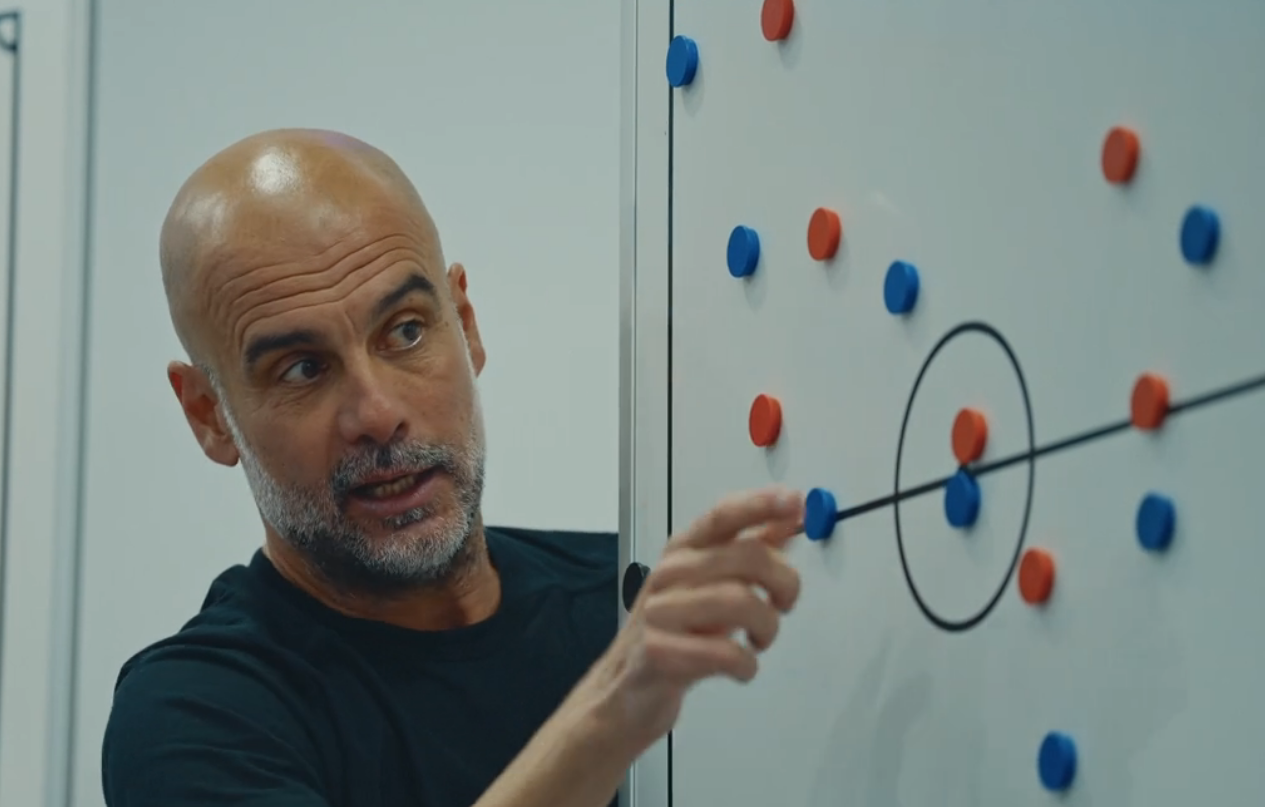
With rotations, Man City can manipulate Arsenal’s defensive structure while maintaining their numerical superiority:
“Zubimendi sometimes follows Bernie [Silva] here; it’s three against two. Always, this three against two. So it is in the left side that we have it …”
After penetrating Arsenal’s defensive line, they can then look to play forward and attack the space created on the far side of the pitch (overload-to-isolate):
"… and after we can go, and after we can find in the second ones, Rayan [Cherki], we can go in that position, and we can find it."
3) Attacking Space Directly
So far, we have considered how ball and player movements can manipulate the opposition to create space, and how these spaces may be exploited through the creation of numerical superiority; these are key ideas in the positional play framework. However, recent trends in the tactical landscape have seen transitional, physical football become more prevalent. This is something Guardiola has recognised:
“The way that modern football is, is the way that Bournemouth play, the way that Brighton play, that Newcastle play … Today, modern football is not positional, you have to ride the rhythm” - Pep Guardiola to TNT Sports in January 2025
Guardiola’s Man City side have also evolved to ‘ride the rhythm’; in 2025/26, City recorded a five-year low in possession, and five-year highs in through balls (50% increase from 2024/25) and fast breaks (source: Premier League). When space is offered by his opponents, particularly behind a high defensive line, Guardiola has shown a willingness to attack it. In these scenarios, the focus shifts from how to manipulate pressure to open forward passing lanes, and instead how to bypass pressure and attack space before the opposition can recover.
An example of this comes from towards the end of episode one, during a Premier League match against Chelsea.
Episode 1: 33:30 - Chelsea (Premier League)
Here, we see Guardiola address his side during half time, with the score at 1-1. Pep encourages his full-backs to attack the half-spaces and instructs deeper players to play lofted passes over the backline into the space they are attacking:
“Make the movement first, the same as we have done with Matheus [Nunes, right-back] with that movement [outside-to-inside run to attack the half-space], the incredible movement from Josko [Gvardiol, left-back] in that situation… and put the ball there, just chip it. … They are so high and that way it will kill them, I promise you.”
More broadly, this instruction shows an intention to play directly. This demonstrates the aforementioned pragmatism from Pep, who was willing to adapt his gameplan to bypass pressure entirely, rather than looking to create space through short passes and movements in the middle third (as seen against Tottenham).
After the match, Guardiola explained the logic behind this decision in a press conference:
“When it’s man-to-man and they jump to the keeper, you can make a two-against-one with the keeper. But when it doesn’t happen, you have to play [long towards] Erling, because if you win that ball it is a chance."
Chelsea played aggressively out-of-possession, utilising a man-oriented 4-4-2 with a particularly high line. They rarely jumped onto Ederson, instead marking his outfield options and denying access to passing lanes. Instead of looking to build from the back (in typical Guardiola fashion), City instead looked to quickly attack the space in behind Chelsea’s backline, with Ederson playing long balls directly towards target man Erling Haaland. Haaland’s elite physical abilities meant he was able to win these balls, holding up play and linking with supporting teammates to exploit space before Chelsea could drop into a low-block. This approach produced a number of chances and resulted in 2 second-half goals to secure 3 points for Man City:
This is a good example of Guardiola’s side playing over the press, exploiting space behind the opposition defensive line. Guardiola is quick to recognise Chelsea’s weaknesses and adapt accordingly. Such examples are important to understanding Guardiola’s tactical approach - rather than a strict ‘rulebook’ of how to play football, Guardiola’s interpretation of positional play is a flexible set of ideas and underlying principles to be shared with his players. By understanding these concepts, Guardiola’s players can intelligently react and adapt to their opponent’s actions, even if this involves abandoning some of these principles altogether in the pursuit of victory.
Final Thoughts
This article serves as an introduction to some of the key ideas which define Pep Guardiola’s interpretation of positional play. One of these key ideas is the use of intelligent movements to disrupt the opposition’s defensive structure. By creating dilemmas for the opposition, his team can force difficult decisions to create space or a free man to receive the ball. Such dilemmas may also be manufactured through the creation of overloads, another key idea I discussed (numerical superiority).
The creation of overloads allows for tight combination play to break through lines and attack space, and can also open space on the far-side of the pitch to be exploited as the attack progresses (overload-to-isolate principle). We saw examples of this against Arsenal, whose compact mid-block could be penetrated by creating wide overloads.
Finally, I considered Guardiola’s more pragmatic approach of recent years. Recently we have seen the rise of ‘heavy-metal football’. With its DNA rooted in German football, the intensely physical, transitional style has been used to great success by managers such as Jurgen Klopp and Andoni Iraola in recent years. This is something that Guardiola - figurehead of the modern positional approach which is often seen as the antithesis to heavy metal football - has embraced when necessary, as we saw against Chelsea. This is reflected in the recruitment of players in recent years, including the shift from false nine profiles such as Gabriel Jesus to the physically elite, classic ‘No.9’ Erling Haaland, and the arrival of Antoine Semenyo from Bournemouth earlier this year. Interestingly, we can also see some signs of this shift in the changes to the backroom staff at Manchester City; Pep Lijnders, who previously worked alongside Klopp at Liverpool, arrived as assistant manager for Guardiola’s last season in charge. This offers an important clarification about Guardiola’s approach. As the most famous figure associated with modern positional football, it would be easy to assume that Guardiola only plays this style of football; other innovative coaches, such as Marcelo Bielsa, are famously vehement idealists who rarely abandon their principles. Earlier in his career, Guardiola may have been considered to be similarly idealistic. However, as he has evolved, he often takes a more ‘bottom-up’ approach in his game model, adapting to the abilities of his players and the demands of the league. Above all, Pep wants to win, and to do so requires evolution and growth.
As I conclude this article, I believe it is necessary to address the elephant in the room which inevitably exists when discussing Guardiola and Man City. Recently, the news broke that an independent commission found Man City guilty of 114 of 115 charges against them. These charges are related to breaches of Premier League financial rules over a nine-year period from 2009 to 2018. This includes the first two seasons of Guardiola’s reign at Man City. Naturally, this will affect the way in which we discuss Man City and Guardiola’s achievements, however I believe that we should not allow off-field activity to overshadow Guardiola’s tactical influence.
Ultimately, while the legitimacy of his achievements at Man City could be questioned, the influence he has had on English football should not; to understand modern football, we must understand Guardiola.
(Thumbnail Image Credit: Steffen Prößdorf , via Wikimedia Commons, licensed under CC BY-SA 4.0. Cropped and modified for this article.)