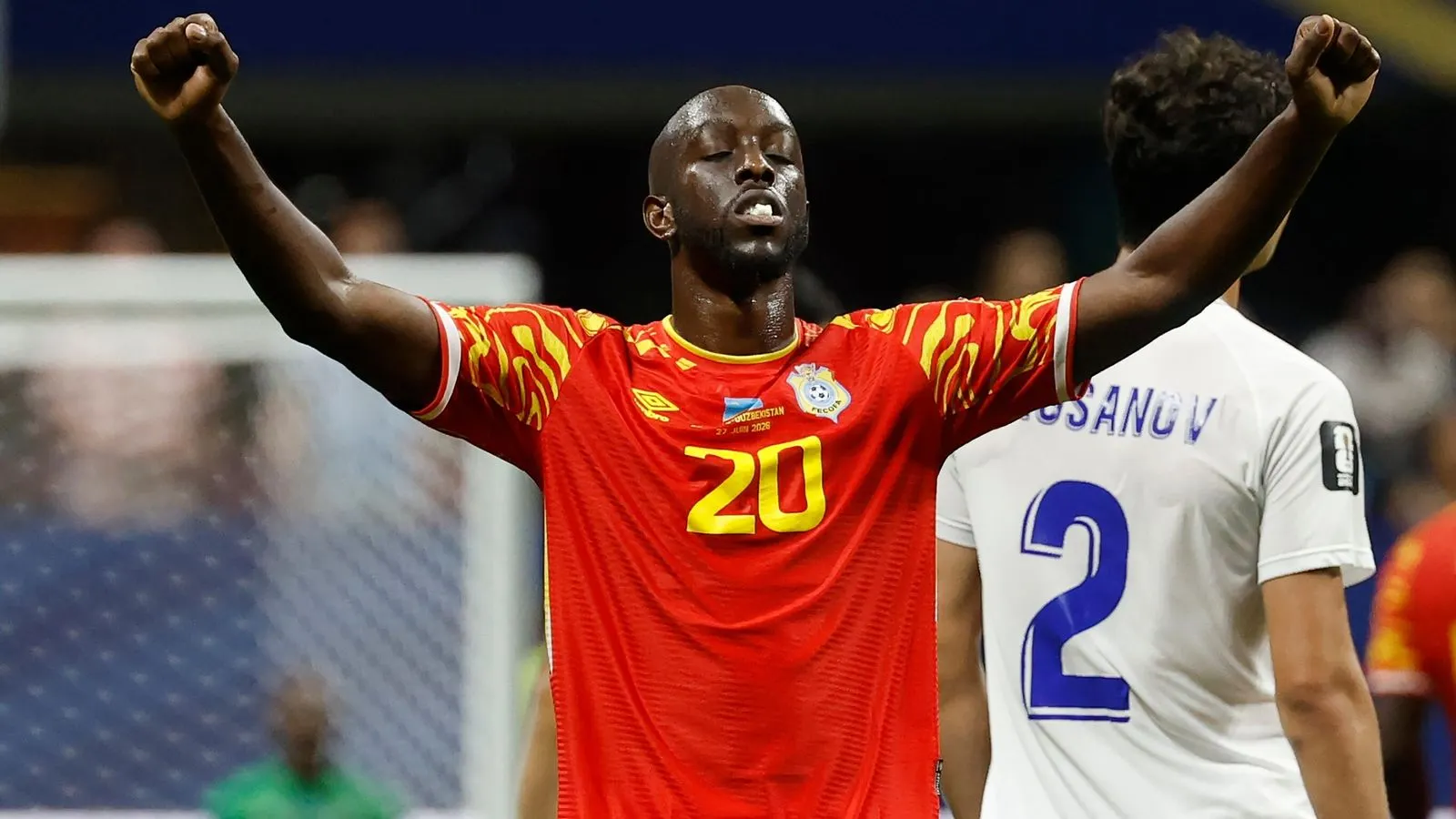
With England going unbeaten to win group L, they will face DR Congo in the RO32 — a favourable draw for the Three Lions on paper, with Opta predicting a 73.9% chance of an England victory. Les Léopards’ 3–1 win over Uzbekistan saw them secure a place in the knockout stages for the first time in their history, finishing as the top-ranked 3rd-placed side in the tournament. So, how will DR Congo set up against England, and how can Tuchel adapt his side to break down their stubborn defensive setup?
DR Congo: In Possession
With DR Congo chasing a win against Uzbekistan, we saw the African side set up in a 4–4–2. However, against more dominant opposition Portugal and Colombia, Les Léopards lined up in a 5–3–2 shape, and we can expect a similar approach against England.

DR Congo are happy to have less of the ball than their opposition, registering 36.5% possession against Colombia and 24.6% against Portugal. With the ball, they play forward directly and aggressively; against both Colombia and Portugal, 16.1% of their passes were long, and in both matches, ~67% of their passes were played forward (Colombia: 68.2%; Portugal: 66.3%).
From deep areas, DR Congo rarely look to play through the press, instead sending the ball long. With two physical №9’s in Wissa and Bakambu and a significant midfield presence, DR Congo look to win their duels and pick up loose second balls high up the pitch. Wing-backs Aaron Wan-Bissaka and Arthur Masuaku provide valuable width to the team, with the former often moving into advanced positions. If possession is retained further up the pitch, Wan-Bissaka is often the outlet for the ball, looking to drive the ball forward along the right-hand side.
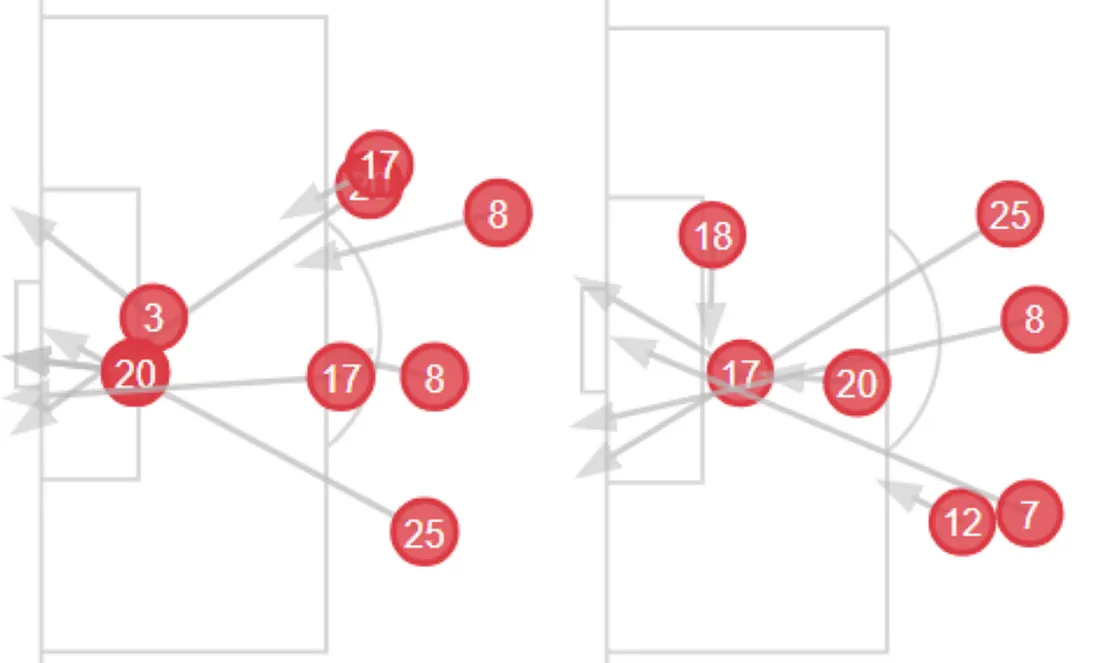
The width offered by both wing-backs is crucial to DR Congo’s approach. When either is on the ball, the near-side striker and central midfielder will often come across to offer support and look to manufacture a crossing opportunity. In the example below, Bakambu and Mukau support Wan-Bissaka, with Wissa drifting centrally to attack the box. Wing-back Masuaku is also positioned high, arriving into the box at the far post.

Against superior opposition, DR Congo struggled to work the ball into the box, primarily taking shots from outside of the box. As a result, the majority of their chances were relatively low-quality, resulting in low xG creation; against Portugal they created 0.87 xG, and over half of this (0.58) was the result of just 2 shots taken inside the box (8 total). Similarly, against Colombia they created just 0.37 xG, with 0.25 coming from inside the box (3 out of 7 total shots). However, striker Wissa is a proven goalscorer, netting 19 times for Brentford in the Premier League 2024/25 season, and so England will still have to be wary of DR Congo’s threat from shooting positions outside of the box.
Out of Possession
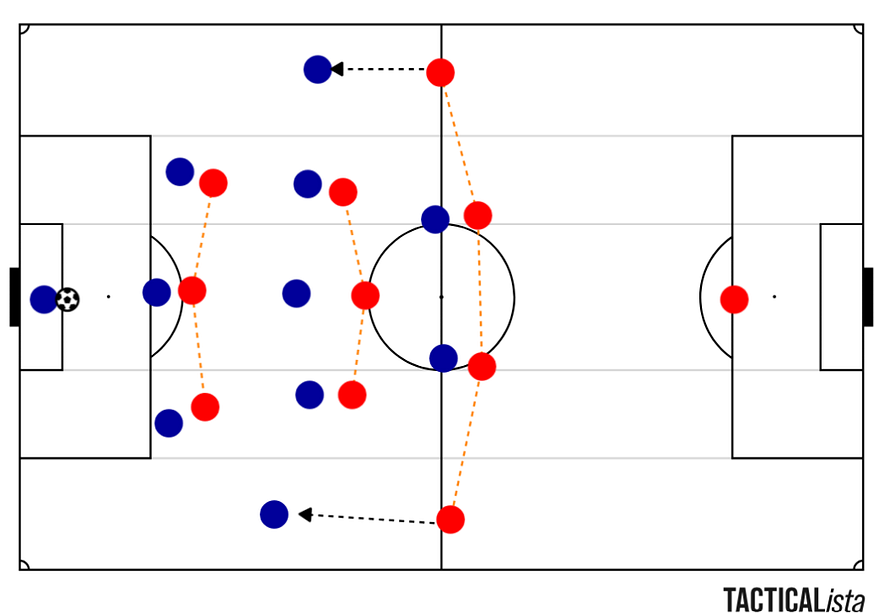
With DR Congo often seeing less of the ball than their opposition, their defensive approach is crucial to their success. They play in a disciplined, compact 5–3–2 mid-block, with their wing-backs sitting back in a flat back 5, responsible for tracking the opposition’s wide men.

The 5–3–2 structure employed by DR Congo. The red lines indicate the pressing/marking responsibilities of each player in this scenario.
This mid-block is not passive, however, with DR Congo often applying pressure as the ball enters the middle third. A common pattern emerges as the ball is played wide to the opposition full-backs, with the narrow Congolese midfield denying central passing options. The Congolese wing-backs, pinned by the opposition wingers, do not step up, and instead we see the near-side wide central midfielder come across to pressure. This avoids disrupting the backline and creating space in wide areas.


However, midfielders stepping out like this can stretch the midfield, leaving space which may be exploited. While Portugal failed to exploit this, England may be able to work the ball forwards through diagonal passes in-field:

In this example, we can see how DR Congo’s (blue) pressing pattern can create space to progress diagonally in-field, when England (red) build in a 4–3–3 shape.
In this hypothetical passage, we can see how the DR Congo press can be beaten through off-the-ball movement into space. If the centre-back tracks the dropping attacking midfielder, the defensive line is disrupted, creating space to be attacked by the left-winger and/or the striker. If the centre-back does not follow his man, he risks allowing a technical player time on the ball.
This is just one example of how England may look to break down DR Congo’s defensive structure. Whether we see this pattern remains to be seen, however it is possible to explore some more general principles that England are likely to adopt.
England’s Approach
Out of Possession
With DR Congo building in a 5–3–2 shape, I expect to see England pressing man-to-man in a 4–3–3, as seen against Panama and Croatia.
With DR Congo seemingly uncomfortable playing out from the back, an intense man-to-man press could catch Les Léopards in possession. With DR Congo likely responding by playing directly, it is important that England win their aerial duels and sweep up loose second balls (an important role Elliot Anderson will likely perform) in order to regain control of possession as soon as possible.
Additionally, England have looked somewhat vulnerable in transition. Against Panama, assistant coach Anthony Barry’s interview at half-time described how England’s turnovers in central areas allowed Panama to threaten on the counter. To stop such counter-attacks from DR Congo, England will likely look to counter-press as soon as the ball is lost, with the aim of rapidly regaining possession. Additionally, with DR Congo’s formation offering control of the midfield, giving the ball away in central areas will undoubtedly lead to danger. I’d expect that Tuchel will look to address this by prioritising wide ball progression, an important aspect of England’s in-possession play.
In Possession
Despite going unbeaten in the group stage, there are concerns regarding England’s ability to break down defensive teams sitting in a low block, with Ghana successfully holding England to a 0–0 draw. With DR Congo likely looking to sit back and nullify England’s attacking threat, with penalties presenting a valuable chance of progressing against superior opposition (as we saw from Paraguay against Germany), it is crucial that England can transform their threat into goals against DR Congo.
England will likely line up in a 4–3–3, shifting into a 3–1–6 shape when in possession; with 6 in the front line, England can outnumber DR Congo’s back 5, something which Tuchel looked to achieve against Panama. In this system, the two more advanced central midfielders (Bellingham and Rogers against Panama) will look to step up into the attacking line, pinning the wider centre-backs. In doing so, they can effectively isolate the wide players 1-on-1 against the opposition wing-backs, providing them the opportunity to take on their man. Additionally, the English full-backs — for example, Nico O’Reilly — will look to get forward, moving in-field and threatening to attack the half space.
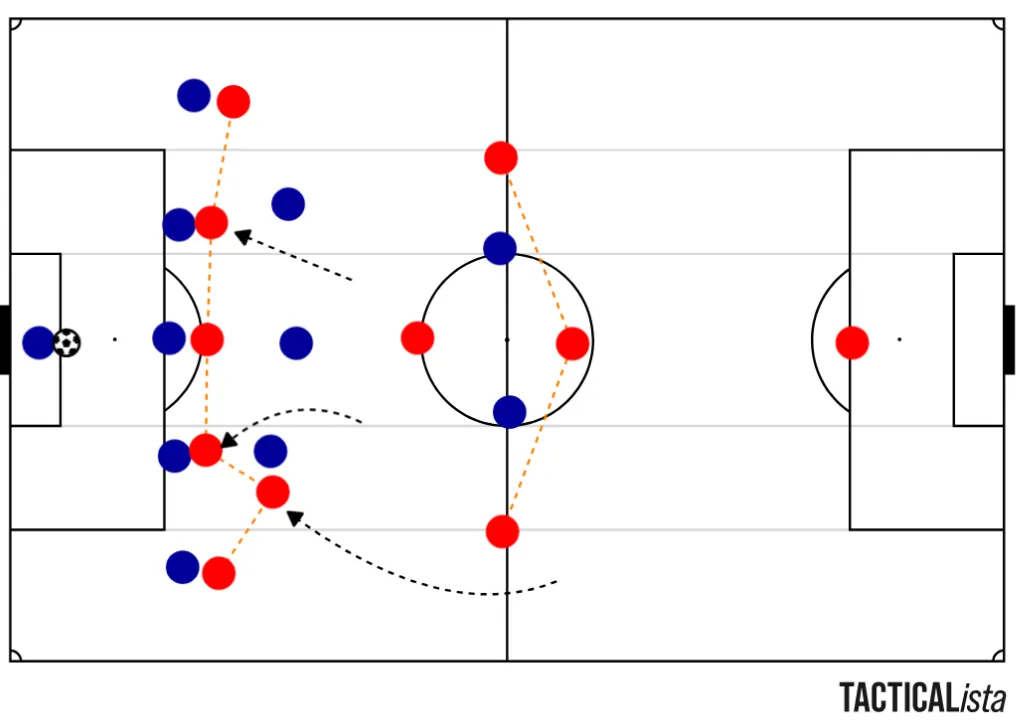
To break down DR Congo’s compact shape, Tuchel’s preferred wide combinations are likely to be important. Rotations in wide areas — between the attacking midfielder, full-back and wide player — should allow England to disrupt the Congolese defensive line. In particular, the English wide players (e.g. Rashford) dropping deep may cause the opposition wing-back to step up, creating space in behind. Combinations and off-ball movements involving in-field players — such as Bellingham and O’Reilly — can allow this space to be exploited, allowing England to break into the final third and attack the box. Furthermore, with DR Congo setting up to deny central spaces, such wide combinations are made even more important.
We can also expect set-pieces to have an important role against DR Congo. When struggling to break down defensive teams, set-pieces may produce valuable goal-scoring opportunities. England have already shown their strength from dead-ball situations, scoring 2 goals from corners (Kane vs. Croatia; Bellingham vs. Panama) so far this tournament. The potential role of set-pieces against DR Congo may influence Tuchel’s selection, including the re-introduction of set-piece specialist Declan Rice, after he remained on the bench against Panama. However, the potential inclusion of Declan Rice is not the only selection problem Tuchel may face.
Team Selection
With Reece James out with a hamstring problem, Tuchel has something of a selection issue at right-back. Against Panama, Tuchel opted to deploy Quansah at right-back, with O’Reilly more frequently getting forward to join the attack. However, given the importance of the wide rotations in this match given DR Congo’s stubborn defensive approach (compared to Panama’s higher line), I expect Tuchel will opt for Djed Spence at right-back (particularly with Quansah picking up an injury). Spence’s pace is valuable both exploiting space in behind and in recovery during defensive transitions, and he makes frequent attacking runs, combining well with Bukayo Saka or Noni Madueke.
In the midfield, I expect that Tuchel will again opt for a more attacking duo in front of Anderson, with Morgan Rogers likely to start alongside Bellingham ahead of Rice. In this 4–3–3 → 3–1–6 system, Rogers offers greater threat than Rice, comfortable operating in tight areas and offering a threat in shooting positions outside of the box. However, there is equally a case to be made for the inclusion of Ebere Eze, another profile that may suit this role. I would expect Eze to get minutes against DR Congo, particularly if the game remains a draw late into the 90. Regardless, I believe Tuchel will retain the same midfield that started against Panama.
Predicted Starting XI —
I predict a largely unchanged XI from England’s 2–0 win over Panama, with just Quansah replaced by Spence:
- Jordan Pickford (GK)
- Djed Spence (RB)
- Ezri Konsa (CB)
- Marc Guehi (CB)
- Nico O’Reilly (LB)
- Elliot Anderson (DM)
- Jude Bellingham (CM)
- Morgan Rogers (CM)
- Bukayo Saka (RW)
- Harry Kane (ST)
- Marcus Rashford (LW)
While the draw against DR Congo should be favourable for England, and I expect that Tuchel’s side should meet expectations and progress, it is important to respect a side which will undoubtedly make it difficult for England (particularly as we have seen teams such as Brazil and Germany struggle against weaker opposition so far). It is important that England play with intensity in attack, and a dominant win could be a real statement of intent from Tuchel’s side.