
Introduction
When looking to quantify a player’s performance, traditional statistics often fall short. Statistics such as goals and assists rarely paint a full picture, as they do not provide any information regarding the relative contributions of either player. Compare, for example, these famous assists by Busquets and De Bruyne:


Both players would be awarded 1 assist for their contributions.
Additionally, more complex metrics such as xG and xGOT are flawed. Whilst they can help to identify the quality of chances created and shots taken, they are largely redundant when considering the performance of non-attacking players.
Even newer metrics designed to address these flaws are not perfect; xGChain (developed by Hudl), for example, aims to quantify the impact of players involved earlier in the possession chain. However, all passes are valued equally in this framework, meaning again information regarding the relative contributions of each player is lost.
VAEP is a metric which addresses this.
What is VAEP?
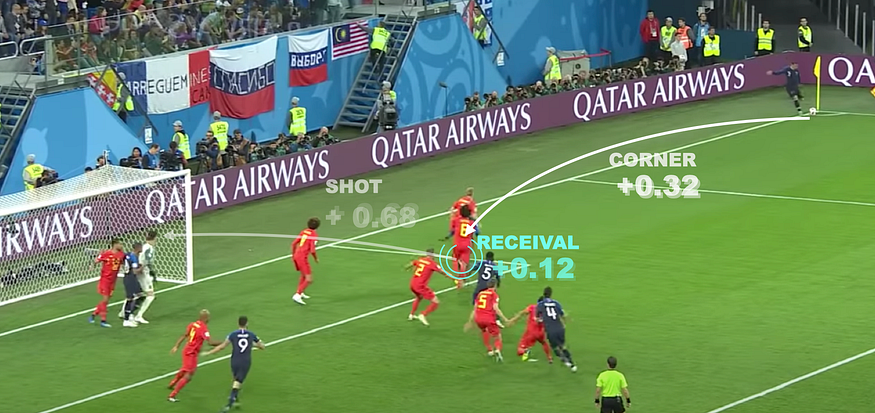
VAEP — or Valuing Actions by Estimating Probabilities — was developed by SciSports and researchers from KU Leuven in 2019.
The core idea of VAEP is that every action a player takes will either increase or decrease the probabilities of (a) scoring or (b) conceding in the immediate future. To estimate this impact, VAEP evaluates several contextual factors, including the action’s location, body part used, direction, and the sequence of preceding actions.
In its simplest terms, VAEP is calculated as:
(Change in probability of scoring within the next 10 actions)
— (Change in probability of conceding within the next 10 actions)
following a given action.
For example, a forward pass which increases the probability that a goal is scored by +0.4 and reduces the chance the team concedes by 0.2, will be assigned a VAEP value of 0.6. Conversely, losing the ball in a dangerous area may change the team’s probability of scoring by -0.3, and increase the probability of the team conceding by 0.5. This would produce a VAEP value for this action of -0.8. Therefore, at face value, a negative VAEP value indicates a reduced chance of scoring / increased chance of conceding, and a positive VAEP value indicates the opposite.
By assigning a value to every action in a possession sequence, VAEP captures contributions that traditional metrics often miss. This makes it particularly useful for identifying players whose impact is subtle but consistently positive.
Comparing players by their average VAEP per action provides a way to quantify the best players in each position, offering a more comprehensive measure of on-ball contribution beyond output.
Methodology
Here, I looked to use VAEP to identify the most valuable players in each position in the EFL Championship. Using the soccerdata and socceraction packages in Python, event-level data for the EFL Championship was retrieved from WhoScored. Playing times and positions were extracted from FotMob.
A VAEP model was trained on a dataset of over 1.7 million actions from the 2022/23 and 2023/24 seasons. This was then validated on a dataset of over 800k actions from the 2024/25 season. Finally, the trained and validated model was tested on a dataset of over 500k actions from the 2025/26 season so far.
For each analysis, I compared the average (mean) VAEP / action and the actions per 90 performed by each player. Using these two statistics, we can assess both the value and the volume of actions performed by any given player. In all cases, only players who have played a minimum of 450 minutes this season were considered.
The Results
In all cases, the VAEP / action (y-axis) is measured against actions / 90 (x-axis). The graphs are split into 4 quadrants, with the vertical division representing the median actions/90 among the cohort. The horizontal division sits at 0.0, the threshold at which a player’s actions can be considered entirely neutral.
Furthermore, to assess overall performance, VAEP/90 was calculated. This combines both measures to determine which players add most value overall. For each position group, notable performers in either metric will be highlighted, alongside the best overall performers in each position.
Forwards

Although Zan Vipotnik ranked 1st in VAEP/action with a value of 0.0134, his low number of actions/90 (26.8; 6th lowest) limits his overall impact. This performance suggests Vipotnik may be viewed as a conventional poacher, adding significant attacking value despite lesser involvement on the ball. Conversely, Nathan Broadhead and Nestory Irankunda impress with the highest actions / 90 values among all forwards in the league (60.3 and 51.7, respectively), yet their overall impact is limited by their modest (yet positive) VAEP/action valuations.
Two of the division’s most elite performers — Mathias Kvistgaarden and Brandon Thomas-Asante — combine high volume and high impact, sitting comfortably in the top-right quadrant. These two players can be recognised as complete forwards.
On the other hand, Kyogo Furuhashi stands out for all the wrong reasons, registering the lowest mean VAEP/action (-0.0117) while also recording the 3rd lowest actions/90 (24).
Overall top performers (by VAEP/90):
- Mathias Kvistgaarden (Norwich City) — 0.565
- Brandon Thomas-Asante (Coventry City) — 0.453
- Ellis Simms (Coventry City) — 0.368
- Patrick Bamford (Sheffield United) — 0.367
- Zan Vipotnik (Swansea City) — 0.360
Attacking Midfielders

Despite recording a largely average number of actions/90 (53.5), Anis Ben Slimane leads in VAEP/action (0.0089), translating to a strong overall impact. Alex Gilbert leads in actions/90 (95.3), although his overall impact is limited by his modest VAEP/action (0.0014).
Ipswich duo Jack Clarke and Jaden Philogene-Bidace are two of the leading attacking midfielders in the league due to their ability to produce a high volume of high-value actions. Sammie Szmodics shows the exact opposite, registering the lowest VAEP/action (-0.0037) and the 2nd lowest number of actions/90 (33.4), making him the least impactful attacking midfielder in the Championship this season.
Overall top performers (by VAEP/90):
- Jack Clarke (Ipswich Town) — 0.555
- Anis Ben Slimane (Norwich City) — 0.475
- Jaden Philogene-Bidace (Ipswich Town) — 0.470
- Femi Azeez (Millwall) — 0.403
- Leo Scienza (Southampton) — 0.382
Central Midfielders

Oliver Rathbone’s exceptional VAEP/action performance (0.0105) is the 6th-highest among all players in the Championship, putting him ahead of all other central midfielders. Rathbone thrives in the quality of actions he produces, despite registering modest numbers of actions/90 (56.3). On the other hand, a handful of players — Hayden Hackney, Marc Leonard, Matt Grimes, Aidan Morris and Imran Louza — stand out due to the high volume of actions/90 they register.
Interestingly, there are few players which place comfortably beyond others within the top-right quadrant, with QPR youngster Kieran Morgan arguably demonstrating this to the highest degree. This pattern may suggest there are two specialist profiles of midfielder in the Championship, producing either a high volume of low value actions (i.e. ‘Workhorse’) or producing a low-volume of high-impact actions (i.e. a ‘Difference-Maker’). We can assign some notable performers to these roles (e.g. Hayden Hackney/Matt Grimes= Workhorses; Oliver Rathbone/Harvey Knibbs = Difference-Makers).
Overall top performers (by VAEP/90):
- Oliver Rathbone (Wrexham) — 0.590
- Jordan James (Leicester City) — 0.443
- Kieran Morgan (QPR) — 0.370
- Victor Torp (Coventry City) — 0.356
- Riley McGree (Middlesbrough) — 0.323
Full-Backs

Looking at full-backs in the Championship, interestingly very few players — just 4 individuals — registered a VAEP/action below 0. The reason for this is uncertain, however it may be related to the way in which VAEP is calculated. Firstly, positioned in wide areas, errors by full-backs (such as being dispossessed) are less likely to greatly increase the probability of the opposition scoring than errors by central players. Additionally, full-backs will often be involved in ball progression and circulation, producing a high number of low-risk, marginally positive actions which smooth out the effects of any large errors.
This pattern makes the 4 players with a negative VAEP/action — Harry Pickering, Harry Clarke, Gregory Leigh and Bright Osayi-Samuel — stand out. One explanation for their unique position may be the fact they play in roles where they are expected to perform higher risk actions, or alternatively this could indicate poor overall performance.
Overall top performers (by VAEP/90):
- Ryan Manning (Southampton) — 0.331
- Femi Seriki (Sheffield United) — 0.284
- Alfie Doughty (Millwall) — 0.265
- Joe Rankin Costello (Charlton Athletic) —0.257
- Chiedozie Ogbene (Sheffield United) — 0.245
Centre-Backs

Looking at the final position group, the centre-backs, we can see Macaulay Gillesphey and Akin Famewo both stand out due to their relatively high VAEP/action (0.0038 for both). Considering actions/90, Luke Ayling ranks highest, with a value of 106. This is likely to suggest Ayling plays an important role in build-up, registering a high number of passes / 90.
In contrast, Christ Makosso of Oxford United ranked lowest in actions/90 (30), which can inform us about the style of football that his team play, largely bypassing the defensive line in build-up.
Overall top performers (by VAEP/90):
- Macaulay Gillesphey (Charlton Athletic) — 0.270
- Jannik Vestergaard (Leicester City) — 0.252
- Luke Ayling (Middlesbrough) — 0.250
- Akin Famewo (Hull City) — 0.214
- Robert Atkinson (Bristol City) — 0.208
Conclusion
Overall, this analysis identifies the most impactful players in each position in the EFL Championship this season. By comparing actions/90 with VAEP/action, we can explore whether a player’s impact is driven by the volume of their involvement or the quality of their individual actions. Combining these measures to produce VAEP/90 allows us to determine which players contribute the most overall, often highlighting those who balance both high involvement and high quality.
Interestingly, this analysis can also provide tactical insight. Comparing actions per 90 with VAEP per action allows us to infer the role a player performs within their team. For defensive and midfield players, this may indicate whether they are heavily involved in build-up play or more frequently bypassed. For attackers, it can reveal whether a player is expected to contribute heavily in possession (for example, a false nine) or instead generate value from fewer actions, as seen with more traditional poachers.
This study demonstrates how advanced metrics such as VAEP can offer a deeper understanding of player contributions. One of the most exciting applications of VAEP is scouting, as the ability to quantify impact beyond output alone provides an opportunity to identify undervalued, yet high-impact talent.